
 by Momchil, founder of My Endurance Life
Vegan, keto, paleo or carnivore? What they share matters more
Six popular ways of eating, one diagram that shows where they overlap, and what it all means when you have a 3-hour ride on Friday. At the end there's a quick test to see which style fits you.
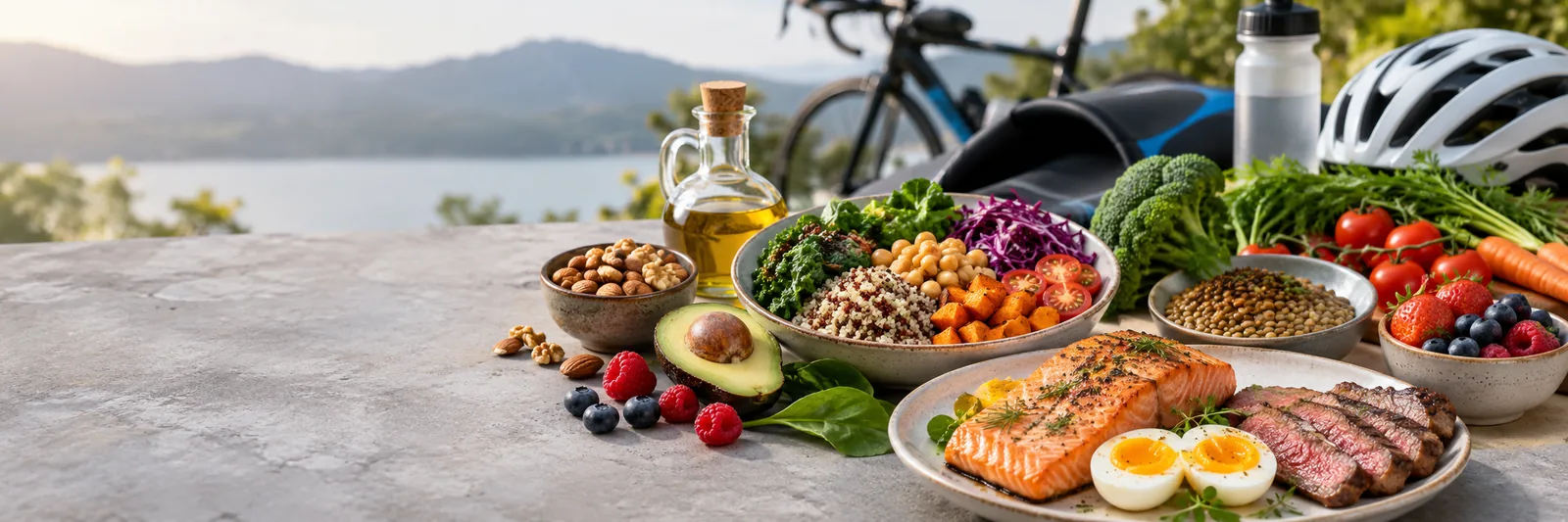
Hey legend! Every triathlon club has at least one vegan, one person who eats only meat, and one who's “been on keto since Monday”. All three are sure they're right 🙂 The good news is that, done well, the three have more in common than they think.
Imagine six different routes to the same summit. They start in different places, BUT before the top they all join the same path. That path is what matters. The folks at Precision Nutrition show it with a great diagram [1]. Here is our version - through triathlon glasses 👓
01 · The diagramSix diets, one foundation
What do healthy diets agree on?
Hover or tap a petal, an overlap or the centre
Idea: “What do most health-focused diets agree on?”, Precision Nutrition [1]. Illustration and triathlon texts: My Endurance Life.
02 · Why they workDifferent rules, the same results
How can total opposites like vegan and carnivore both help people? Precision Nutrition's answer: done well, effective eating plans are more alike than different [2]. With both, the crisps, wafers and fizzy drinks disappear. You eat more real food, you think about what goes on your plate and you usually eat more protein. The diet itself is more like the packaging 📦
BUT for a triathlete there's one more point the general diagrams miss: fuel. You train 8-12 hours a week. Your body needs energy for those hours and for everything else - hormones, bones, immunity. If it falls short, we're talking about REDs (Relative Energy Deficiency in Sport). The latest IOC consensus stresses that low carbohydrate intake speeds up problems with bones, immunity and iron [5]. That's why our centre has 2 triathlon points 🏊
03 · CarbohydratesWhere is your zone?
The biggest difference between the diets is how many carbs they allow. In triathlon that's also the most important one. ACSM recommendations for athletes are 3-10 g of carbohydrate per kg of body weight per day (up to 12 for extreme loads), depending on how much and how hard you train [3]. Pick your week and see which diets land in the zone.
Carbohydrate scale · g per kg per day
Top: how many carbs the diet provides if followed strictly (approximate). Dashed box: how much you need for the chosen week.
Diet positions are indicative: plant-based or Mediterranean can also end up low in carbs if you're not careful. Zones follow ACSM 2016 [3].
This is also where the most famous study on the topic comes in. Louise Burke put elite race walkers on a keto diet for 3 weeks. Their bodies really did start burning far more fat. BUT at race pace they needed more oxygen for the same speed, and so lost the benefit of the training block. The high-carb groups improved [6]. Fat is like diesel - it goes far, BUT it won't give you the kick for the climb or the final sprint ⛽
04 · One by oneWhat each means for triathlon
05 · TestWhich style fits you?
8 quick questions. There are no right answers - answer how it is, not how it “should” be 🙂 The test doesn't tell you which diet is best in general. It tells you which one you'll stick with given your training and your life.
In short
- Good diets share the same core: real food, enough protein, lots of vegetables, little processed food.
- Triathletes have 2 extra points: fuel the training and drink (with salt).
- The more and the harder you train, the more carbs you need. Keto and carnivore pay the price exactly at pace.
- The best diet is the one you'll stick with until race day. And after it.
Write to me. With us, nutrition is planned together with training - more fuel on hard days, less on easy ones. No forbidden foods and no drama.
Sources
- St. Pierre B. The carnivore diet: Can it really transform your health? Precision Nutrition (инфографика „What do most health-focused diets agree on?“). precisionnutrition.com
- Precision Nutrition. Paleo, vegan, intermittent fasting… Here's how to choose the absolute best diet for you. precisionnutrition.com
- Thomas DT, Erdman KA, Burke LM. Position of the Academy of Nutrition and Dietetics, Dietitians of Canada, and the American College of Sports Medicine: Nutrition and Athletic Performance. 2016. dcjournal.ca
- Jäger R, et al. International Society of Sports Nutrition Position Stand: protein and exercise. J Int Soc Sports Nutr. 2017;14:20. pubmed
- Mountjoy M, et al. 2023 International Olympic Committee's (IOC) consensus statement on Relative Energy Deficiency in Sport (REDs). Br J Sports Med. 2023;57(17):1073-1097. pubmed
- Burke LM, et al. Low carbohydrate, high fat diet impairs exercise economy and negates the performance benefit from intensified training in elite race walkers. J Physiol. 2017;595(9):2785-2807. pmc
- Rogerson D. Vegan diets: practical advice for athletes and exercisers. J Int Soc Sports Nutr. 2017;14:36. pmc
- Harvard T.H. Chan School of Public Health. PREDIMED Study Retraction and Republication (Estruch R, et al. NEJM 2018). hsph.harvard.edu
- Lennerz BS, et al. Behavioral Characteristics and Self-Reported Health Status among 2029 Adults Consuming a “Carnivore Diet”. Curr Dev Nutr. 2021;5(12):nzab133. pubmed
- Precision Nutrition. The Paleo diet: Your complete how-to guide. precisionnutrition.com
- Kirwan R, et al. Limitations of Self-reported Health Status and Metabolic Markers among Adults Consuming a “Carnivore Diet”. Curr Dev Nutr. 2022;6(5):nzac037. pmc
Momchil
More to read
-
 Article
Quick food for busy athletes: 20 easy meals
You train, you work, you have a family – and there are 15 minutes left for cooking. Here is how to eat enough, and eat well, without living in the kitchen.
-
 Article
Triathlon camp in Mallorca: 10 nutrition questions
Race-day breakfast, simple vs. complex carbs, fasted intervals, sugar and carb loading. Real questions – asked by the camp participants.
-
 Article
Project Sub10: my goal is an IRONMAN under 10 hours
A first full distance, limited triathlon experience and one bold goal. Why now, who’s behind me, what the numbers say – and how it ended.
Ready for your best season?
Tell us where you are now, which race you are preparing for and what support you are looking for. No commitment, just the first step towards a better plan.